
Linear Gate Repair in Fontana: A Homeowner’s Guide
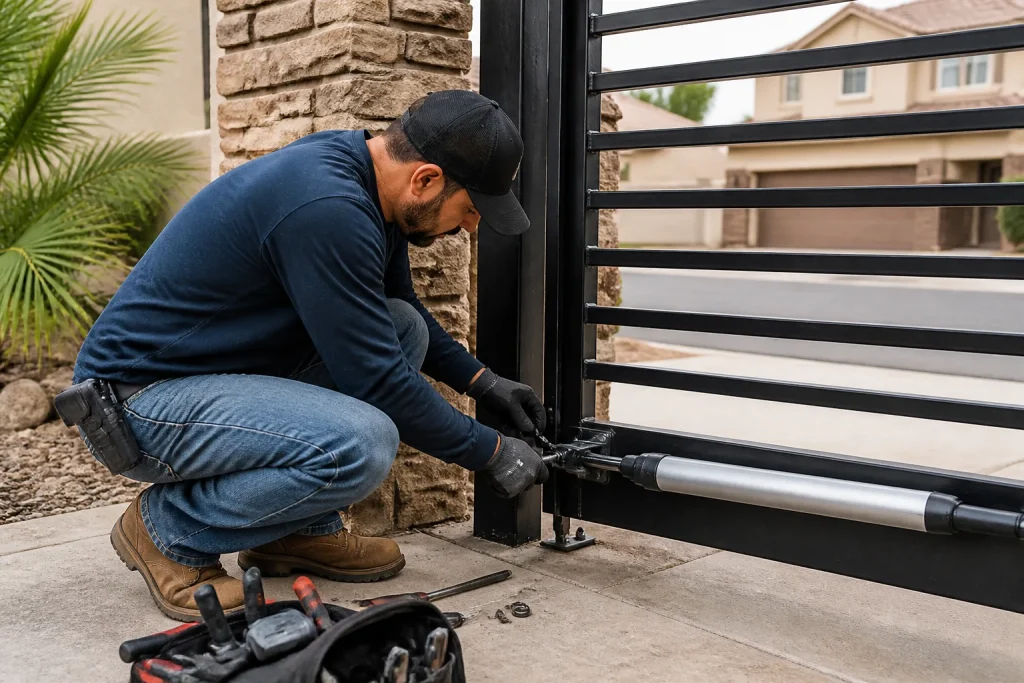
Linear gate operators fail in three predictable ways: the MegaCode receiver loses sync with your remotes, the circuit board takes a hit from a power surge, or the motor capacitor wears out and the gate starts moving like it’s wading through mud. Most of the time the operator itself is fine. What it needs is someone who knows which of those three things to check first. If you’d rather not spend your Saturday with a multimeter, call (844) 703-6053 and we’ll sort it out.
Why Linear Operators Show Up Everywhere in Fontana
Drive through any Fontana neighborhood built between 2005 and 2020, and you’ll see the same pattern: wrought-iron driveway gates with a beige or gray Linear control box mounted near the hinge post. Developers in Rancho Fontana, Sierra Lakes, and the newer subdivisions off Beech Avenue spec’d Linear because the units were affordable at builder volume and simple enough that a general contractor could wire one without a dedicated gate technician on the crew.
That install volume means something important for you as a homeowner: nearly every gate company in the Inland Empire has touched a Linear at some point. But “touched” and “diagnosed correctly” are different things. We’ve pulled into driveways where a previous technician declared the whole operator dead, only to find the issue was a disconnected limit switch wire or a receiver that needed a two-minute reprogramming sequence. Linear’s architecture is straightforward once you understand it. Most generalists don’t understand it.
We work on the brand you already have. That includes Linear, but also LiftMaster, FAAC, BFT, and five other major automation brands. No “we don’t service that” dead ends.
What Makes Linear Different From Other Gate Brands
Linear operators, particularly the AE series (AE100, AE1000, AE2000), use a modular design that separates the control board, the radio receiver, and the power supply into distinct components. That’s different from LiftMaster’s more integrated approach, where the receiver is typically built onto the main logic board. It’s also different from FAAC and BFT hydraulic units, which rely on fluid pressure rather than a direct-drive motor and capacitor setup.
Why this matters for repair: on a Linear, you can replace just the receiver board or just the capacitor without touching the rest of the system. That modularity keeps repair costs down when you’re working with a technician who actually carries Linear parts or knows the compatible aftermarket equivalents. When a single-brand dealer shows up and says you need a full replacement, what they’re often telling you is they don’t stock the part you actually need.
The right fix, not the easy upsell. That’s the standard we work to on every call in Fontana.
The MegaCode System: Why Your Remote Stopped Working
Linear’s MegaCode is a rolling-code radio protocol. Every time you press the button on your remote, the transmitter sends a new code from a sequence of millions. The receiver on your gate knows what the next code should be. If someone tries to capture and replay your signal, that captured code is already burned, so it won’t work. It’s a solid security design, and it’s one of the reasons Linear became a default choice for Fontana HOAs concerned about driveway access.
But rolling-code systems have a failure mode that confuses homeowners: desynchronization. If you press the remote button too many times while the receiver is powered down, or if the receiver board loses power while the remote is transmitting, the two units drift apart in the code sequence. The remote still works. The receiver still works. But they’re no longer on the same page, so nothing opens.
Here’s what a homeowner can verify before calling anyone:
- Check whether a second remote still opens the gate. If one remote works and another doesn’t, the issue is that transmitter, not the receiver. Replace the battery first, then try reprogramming just that remote.
- If no remotes work, but the gate opens from the keypad or the interior push-button, the receiver itself has likely lost sync or power. The receiver board is a small box, usually wired separately from the main control board. Check for a solid red LED when you press the remote. No LED means no power to the receiver or a dead receiver board.
- If the LED blinks but the gate doesn’t move, the receiver and board are not communicating. On most Linear AE models, that’s a two-wire relay connection that can corrode or loosen. Tightening a terminal screw sometimes restores function immediately. We’ve done exactly that on a gate in the Hunter’s Ridge area off Duncan Canyon Road, and the homeowner was convinced the whole unit needed replacing.
The actual re-sync procedure varies by model year. On some units, you hold the learn button on the receiver for three seconds until the LED flashes, then press the remote button twice. On others, you need to clear the memory entirely and re-learn all remotes one at a time. We walk homeowners through this over the phone when it’s safe and simple. When it’s not, we send a technician who has done it hundreds of times.
The Reset That Most People Get Wrong
Here’s the part competitors won’t tell you because it doesn’t sell parts: many “dead” Linear receivers are fixable with a reset sequence the homeowner manual barely mentions. The MegaCode receiver on AE series operators has a small recessed button, often labeled with the word “LEARN” or marked with a single dot. Holding that button for a full ten seconds, not three, clears all stored transmitter codes. On units where the memory is corrupted, that full clear is the only fix short of board replacement. A technician who doesn’t know the ten-second clear will quote you a new receiver. That’s a $200 to $400 part plus labor you didn’t need to spend.
Of course, if the receiver board has visible burn marks or water damage, resetting won’t help and replacement is the honest recommendation. We’ve replaced enough of them to know the difference at a glance.
Power Surges and Linear Boards: A Fontana-Specific Problem
Fontana summers push the grid hard. When temperatures climb past 100 degrees – which they do reliably from June through September – air conditioners across the city cycle on simultaneously, and voltage sags and spikes ripple through residential feeds. For most electronics, those fluctuations are an inconvenience. For a Linear AE series control board, they can be fatal.
The AE1000 and AE2000 boards use a transformer-based power supply with limited onboard surge filtering. A direct hit from a nearby lightning strike or a hard spike when SCE switches substations can burn a trace right off the board. We’ve opened control boxes in Fontana and found the board’s low-voltage section charred while the operator motor itself was perfectly fine.
Here’s what you can do to protect your Linear system:
- Install a surge protector at the gate’s power disconnect. Look for a Type 2 surge protection device rated for outdoor use, wired between the breaker and the operator. This is a $75 to $200 part that can prevent a $500 to $900 board replacement.
- Check the gate’s ground wire. Linear explicitly requires a dedicated ground for the operator chassis. We’ve seen Fontana installs where the ground wire was never connected, or where it corroded off over five to ten years. No ground means surge energy has nowhere to go except through your control board.
- After any major storm or brownout, test the gate from every access method: remotes, keypad, hardwired button. If the gate opens from the hardwired button but not the remote, your receiver took the hit. If nothing works, it’s the control board or the power supply.
If you’re in Fontana and your gate stopped working right after a summer storm, call us before you buy parts. We’ll diagnose the actual fault and give you a straight answer on what needs replacing.
The Motor Capacitor: The Most Common Cause of a Slow Gate
A Linear gate that moves slower than normal, groans on startup, or stalls halfway through its travel is almost always telling you the motor capacitor is wearing out. The capacitor stores and releases the burst of energy the motor needs to start spinning under load. Over five to ten years of daily operation in Fontana’s heat, the capacitor’s internal dielectric breaks down. The motor still runs, but it can’t produce enough starting torque to move the gate leaf smoothly.
Homeowners notice the symptoms gradually. The gate was fine for years. Then it seemed a little sluggish in the winter. Then it started pausing mid-travel and resuming after a few seconds. Then one morning it won’t open at all. By that point, the capacitor is fully dead and the motor is drawing locked-rotor current every time someone presses the button, which will eventually damage the motor itself.
Here’s what to verify before ordering a replacement capacitor:
- The capacitor’s microfarad (µF) rating, printed on the side of the cylinder. Most Linear AE series operators use a capacitor rated between 40 and 60 µF, but the exact value varies by model. Do not substitute a different rating. A capacitor that’s too small won’t start the motor. One that’s too large can overheat the windings.
- The voltage rating. Linear specs at least 370 VAC for these start capacitors. A 250 VAC unit is not a substitute.
- The physical dimensions. The capacitor mounts inside the control cabinet, and fitting the wrong size is a fire hazard.
Replacing a capacitor is a straightforward job for a trained technician, but it involves handling components that retain a voltage charge even when the gate is unplugged. A hybrid capacitor can discharge through you with enough force to stop your heart. This is not a “watch a YouTube video in the driveway” project. Get someone who does this for a living.
Residential AE Series vs. Commercial Linear Units: Why the Repair Approach Differs
Linear makes operators for both residential and commercial gates, and the differences matter when something fails. The AE series – AE100, AE1000, AE2000 – is designed for residential use. It’s a single-phase unit with a limited duty cycle, meaning it’s rated for a certain number of open-close cycles per hour. Linear’s commercial units, including some the company produced for light-industrial gates, are continuous-duty machines with different motors, different boards, and different safety logic.
We sometimes see residential Linear operators installed on gates that get commercial-level traffic. A driveway gate serving four homes in a Fontana HOA common area, for example, might cycle fifty times a day when it was rated for fifteen. The same symptoms show up – overheating, motor fatigue, premature capacitor failure – but the actual fix differs. On a residential unit, you replace the failed component and live with the duty-cycle limit. On a misapplied unit, the honest recommendation is to upgrade to an operator rated for the actual traffic. That’s the difference between a repair that lasts two years and a repair that lasts two months.
Our team diagnoses the actual fault regardless of manufacturer. We don’t push full-system replacements when a component repair makes sense. And when a replacement does make sense, we’ll tell you why and give you a written price before any work starts.
Board Replacement vs. Firmware Reconfiguration: What a Generalist Misses
Linear control boards from the last fifteen years have service-level configuration options that most homeowners and many technicians never see. These aren’t in the homeowner manual. They’re accessed through a series of button presses on the board itself, and they control things like dual-gate stagger timing, auto-close intervals, and obstruction sensitivity thresholds.
Here’s a real scenario we’ve seen more than once. A Fontana homeowner has a gate that opened fine, but the auto-close function stopped working. The previous technician quoted a new control board at $650 plus labor. When we arrived, the board was fine. The auto-close timer had simply been disabled – possibly during a previous service call, possibly by a power surge that reset the configuration to factory defaults. Thirty seconds of board-level reconfiguration fixed it. No parts, no board, no replacement.
This is where brand-agnostic diagnostics make the difference. A technician who works on Linear, LiftMaster, FAAC, BFT, Viking, Ghost Controls, DoorKing, Elite, and Mighty Mule operators all day learns the architecture of each. They know which symptoms point to hardware failure and which point to configuration drift. A general handyman with a screwdriver and a multimeter doesn’t have that depth, and the result is often an unnecessary parts bill.
When a board genuinely does require replacement – which happens when there’s visible damage, failed relays, or a processor that won’t boot – we carry or can source the correct Linear part and match the replacement board’s firmware to your operator’s model year. We never install a board and hope it works. We verify it before we leave the driveway.
When to Call a Pro: A Short Cutoff Point
If you’ve checked the breaker, tested remotes and found them working, and the gate still won’t move, stop there. The remaining possibilities include the motor capacitor, the limit switches, the safety loop detectors, and the control board itself. All of those involve either live voltage or components under spring tension. A gate that weighs 400 pounds doesn’t care whether you meant to be in its path. Safety devices exist for a reason, and bypassing them because a YouTube video told you to is how people get hurt.
The same goes for the operator arm and hinge hardware. A gate that’s binding on its hinges will strain the operator, overheat the motor, and shorten the life of every electronic component in the box. We’ve adjusted gates in Fontana where a quarter-inch misalignment was killing a perfectly good Linear operator.
Related services in Fontana: if your Linear operator has failed beyond reasonable repair, our Electric Gate Repair in Fontana team can assess the whole system – operator, receiver, loops, and safety edges – before you spend money on partial fixes. If the operator itself is sound but the gate structure is sagging or the posts have shifted, Gate Repair in Fontana covers the mechanical side. And if your existing Linear is genuinely at the end of its service life, Gate Installation in Fontana walks you through replacement options without pushing a brand you don’t already trust.
The Bottom Line
Linear gate operators are common in Fontana for good reason: they’re modular, reasonably priced, and the MegaCode receiver gives you real security at the driveway. But when they fail – and in Fontana’s heat and grid conditions, failures happen – the fault is usually in one of three places: the receiver sync, the board’s power handling, or the motor capacitor. A technician who knows Linear architecture can fix most of these issues in a single visit, often without replacing the operator. A technician who doesn’t know Linear will quote you a new gate and hope you don’t ask questions.
If you’re in Fontana and your Linear gate is acting up, Manor Gate Repair offers free estimates. Call (844) 703-6053 and we’ll diagnose what’s actually wrong. From diagnosis to installation, your gate restored to spec.
And by the way – we pulled a Linear receiver out of a control box over in the neighborhood north of Summit Heights last week. The homeowner had been told the whole operator was dead by another company. The receiver’s ground wire had corroded clean off the terminal. New spade connector, tightened screw, gate worked like it was brand new. We charged for the service call and the connector. He didn’t need a $2,800 new operator. He just needed someone who looked at the right thing.
Frequently Asked Questions
Most Linear gate repairs in Fontana run between $180 and $650 depending on the component. A MegaCode receiver replacement typically costs $200 to $400 with labor. A motor capacitor replacement runs $150 to $300 installed. A full control board replacement on an AE series operator is $500 to $900 parts and labor. Every quote we give is confirmed in writing before work starts, and the price you approve is the price you pay. Call (844) 703-6053 for an exact quote on your specific Linear model. Estimates are free.
Nine times out of ten, a suddenly dead Linear remote is a battery issue or the remote has fallen out of sync with the MegaCode receiver. If other remotes still work, replace the battery first. If no remotes work, the receiver itself likely lost sync or power and needs a reset or replacement. The reset procedure takes about three minutes in most cases. If you’d rather not troubleshoot, call us and we’ll handle it.
Yes, and it happens regularly during Fontana’s summer storm season and heavy AC-usage periods. The AE series control boards have limited onboard surge protection. A hard voltage spike can burn the low-voltage section of the board while leaving the motor and receiver untouched. Installing a Type 2 surge protection device at the gate’s disconnect, and verifying the ground wire is connected, prevents most of these failures.
If your Linear operator is less than ten years old and the failure is a capacitor, receiver, or limit switch, repair makes financial sense. If the board is burned, the motor is seized, or the unit was undersized for your gate’s weight and daily cycles, replacement may be the better long-term decision. We’ll give you both options with real numbers. The right fix, not the easy upsell.
Written by the team at Manor Gate Repair, serving Fontana since 2014.
Need Gate Repair Help?
Call Manor Gate Repair — licensed & insured, here with fast after-hours help in Fontana.
(844) 703-6053